image: "/blog/muslim-girls-playtime-representation-hero.webp" title: "Muslim Girls Deserve Playtime Representation Too" description: "Why the modest fashion boom should reach the toy box, and how hijabi sticker books help Muslim girls play as themselves." date: "2026-05-28" slug: "muslim-girls-playtime-representation" category: "Representation" tags:
- muslim girls representation
- playtime
- muslim girls
- hijabi sticker books
- modest fashion
I keep thinking about a tiny moment that should've been ordinary.
Blair wanted to bring sticker books to some friends at the masjid. She was excited in that way kids get when they already know the gift is going to be fun. We checked stores, scrolled online, and kept coming up empty. Everything had princesses, pets, mermaids, glitter. None of it looked like the girls she actually knew.
That was the part that stuck with me. Not the disappointment. The speed of it. How quickly a simple Saturday errand turned into a lesson about how little the market expects Muslim girls to exist in the first place.
The runway is loud. Playtime is where kids live.
Muslim and modest fashion is having a real moment right now. You can see it on runways, in creator reels, in the way more brands are finally admitting that hijab and modest style are not side notes. They are part of how millions of people dress, shop, and show up in the world.
I like seeing that. I really do. It matters when Muslim women are visible in glossy places that used to skip over them.
But a six-year-old does not live on a runway.
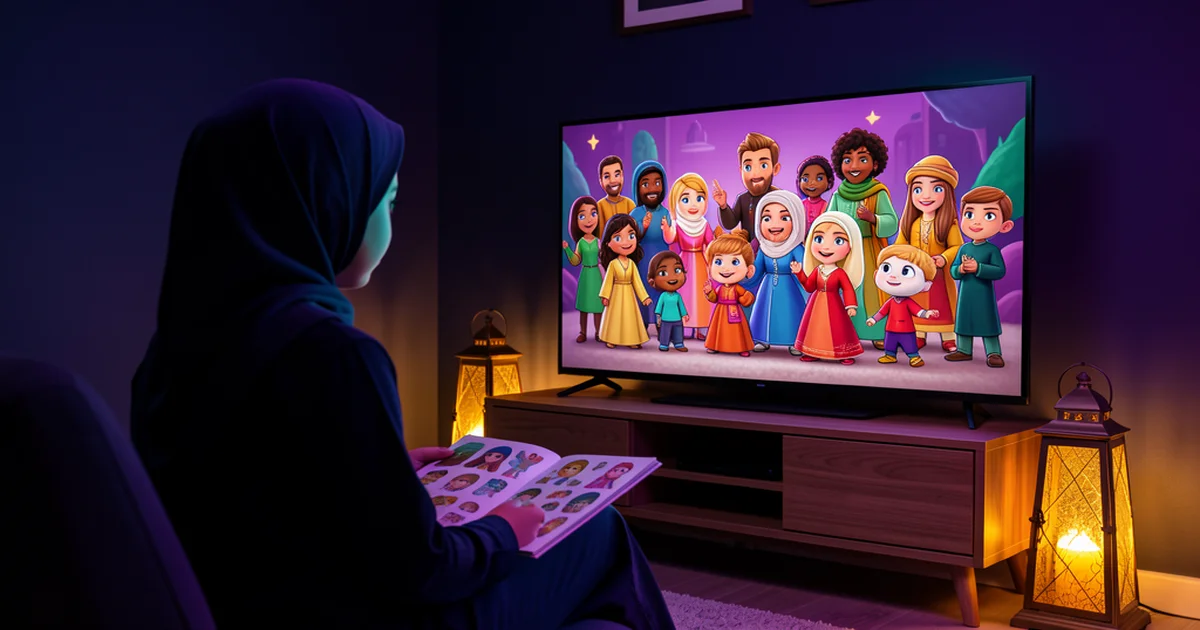
She lives on the floor with markers scattered around her, or at the kitchen table, or in the quiet corner of the masjid after prayer when the grown-ups are still talking and she has five minutes to open something fun. That is where representation gets real. Not in a headline. In her hands.
If the only place she sees herself is in adult fashion coverage, something important is still missing.
Representation is not one thing. It has layers.
People usually talk about representation like it is a single checkbox. You put a hijabi model in the campaign. You include a Muslim character in the show. You move on.
Kids do not experience it that way.
A child notices the details. She notices whether the doll wears hijab. Whether the sticker set has a girl who dresses like her aunt. Whether the game lets her build a face that feels familiar. Whether the colors and clothes and hairstyles make room for her without turning her into a special episode.
That is why I think the conversation around Muslim girls has to go beyond visibility. Visibility is nice. Belonging is better.
There is a difference between "we see you" and "you can play here too." The second one matters more when you are eight.
And honestly, this is not a dramatic theory. It is what happened in our own house. Blair could see a gap before any of us could explain it. She just knew the shelf was missing something. Kids are like that. They notice absence faster than adults do.
Why sticker books made sense
When we started Salam Lanterns, we were not trying to build a grand media empire or solve childhood in general. We were trying to make the thing Blair could not find.
That is how Little Hijabi Adventures came to life first. It is for little kids who want scenes that feel close to home: family, play, everyday joy, Eid, errands, the small stuff that makes a childhood feel lived-in.
Then Beautiful Hijabi followed, because some kids want to build a face. They want to pick the eyes, the smile, the hijab style, the skin tone, the whole thing. That matters more than people think. There is something grounding about building a character that looks like you without having to explain why it matters.
And Modest Hijabi Fashion came later for older girls who are starting to care about style. They notice matching, color, and what feels like them. That book is for the age when fashion stops being abstract and starts feeling personal.
We also made the Beautiful Hijabi App because not every kid wants paper in her hands all the time. Some want to tap, create, save, and keep going. It is $2.99 one time, with no ads and no subscriptions.
The gap is bigger than one product
I want Muslim girls to grow up without having to hunt for themselves in every category.
A sticker book. A character in an app. A doll with hijab. A game that does not make your daughter feel like she is visiting someone else's childhood.
That is why the current moment matters to me. The modest fashion conversation has gotten louder, and parents are asking sharper questions. If there is money and attention for the runway version of Muslim identity, why does the toy aisle still feel so empty?
I do not think parents are asking for a lot. They want their daughters to open something, play for twenty minutes, and feel normal inside it.
What I hope happens next
I hope more brands notice this space, but I also hope they do not stop at surface-level inclusion. Muslim girls do not need a token character dropped into a larger machine. They need products built with them in mind from the start.
That is the difference between decoration and care.
We are still building. More books. More apps. More things we haven't figured out yet. Parents write to say their daughter lit up when she saw a hijabi character, and that confirms the obvious: this was never a weird niche thing.
It was just missing.
If you have been looking for something your daughter can actually see herself in, start with the books. Or try the app. Then come back and tell me what she thinks, because that part never gets old.