image: "/blog/muslim-girls-representation-research-childrens-books-hero.webp" title: "What Happens When Muslim Girls Only See Themselves 1% of the Time" description: "New research shows Muslims appear in just 1% of children's books — and Muslim girls feel the gap most. Here's what that means and what families are doing about it." date: "2026-05-31" slug: "muslim-girls-representation-research-childrens-books" category: "Representation" tags:
- muslim girls representation
- childrens books diversity research
- hijabi sticker books
- muslim toys
- diverse childrens literature
When researchers at EdTrust crunched the numbers on children's literature last year, they found something that shouldn't surprise anyone but still stings: Muslims make up roughly a quarter of the world's population, yet they show up in about 1% of the books published for young readers in the United States and UK. One percent. Not ten, not five — one.
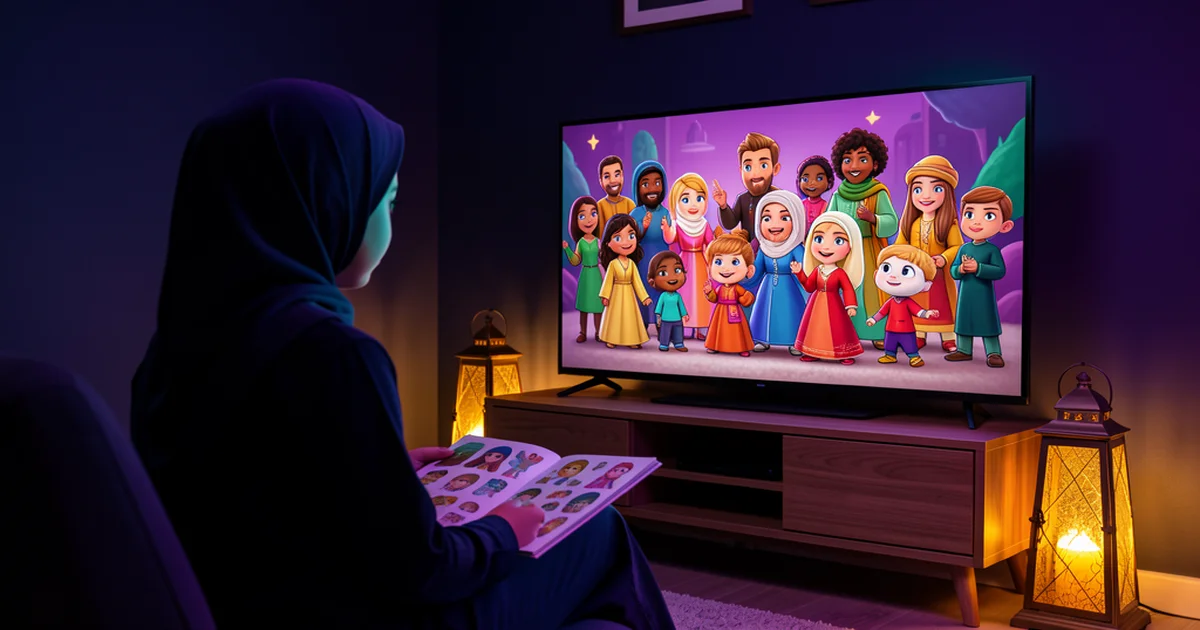
Think about what that means in practice. A Muslim girl walks into a bookstore or opens a reading app. She sees hundreds of characters having adventures, solving problems, going to school, making friends. Almost none of them look like her. Almost none of them wear a hijab. Almost none of them have names like hers, eat the food her family eats, or pray the way she prays.
She learns, quietly, that stories are not really for her. They're for someone else.
The research keeps saying the same thing
It's not just one study. The Institute for Social Policy and Understanding (ISPU) published findings in 2025 showing that when Muslim characters do appear on screen, more than 60% of them are targets of xenophobia, racism, or Islamophobia. That's according to USC Annenberg's data, which tracked hundreds of films and shows over a multi-year period.
So when Muslims do show up, they often show up as the problem — not as the kid who just wants to play, or the teenager figuring out friendships, or the little girl picking out stickers.
CAIR California summed it up bluntly in a report last summer: "Who gets to tell our stories?" The answer, too often, is someone who isn't Muslim and doesn't understand that being Muslim in the West isn't a monolith. It's a kid in a hoodie at the masjid playground. It's a teenager trying to match her hijab to her outfit for picture day. It's a five-year-old who wants a doll that wears a headscarf.
What families are actually doing about it
Here's where it gets interesting. Parents aren't waiting for publishers to catch up.
Over the last year, I've watched a market bloom from the ground up. Little Hijabys makes dolls with hijabs and modest clothing. Lala + Mo sells Muslim-themed toys built around identity and self-esteem. Desi Doll Company's Islamic educational toys just landed on the shelves at The Entertainer, one of the UK's biggest toy retailers — which, if you think about it, is kind of a big deal. A Muslim doll on the same shelf as Barbie.
On TikTok, Muslim moms are posting videos with captions like "Finally, dolls that actually look like my daughter." An Instagram reel from earlier this year — just a simple video showing hijabi dolls next to mainstream ones — got thousands of views and comments from parents saying the same thing: "Where was this when I was growing up?"
And sticker books. Honestly, sticker books don't get the same press as dolls, but they matter more than people think. A doll is one character. A sticker book is a world you build yourself. You pick the outfits, the scene, the story. For a Muslim girl who has never seen a hijabi character she could dress up and play with, that's not just fun. That's seeing herself reflected back, and then getting to shape what that reflection looks like.
That's what Blair noticed when she went looking for a gift. She wanted something for her friends at the masjid — something fun, something normal, something that said "you exist and you're cool." She couldn't find it. So we made it.
The 1% problem isn't going away on its own
The studies keep coming. The headlines keep repeating. And the gap stays roughly the same size year after year.
But the difference now, compared to five years ago, is that Muslim families aren't just pointing at the problem. They're building the alternatives. An app here. A sticker book there. A doll line that gets picked up by a national retailer. None of these alone solves the 1% problem. But together, they're creating a shelf that didn't exist before — a place where a Muslim girl can walk in and see something that was made with her in mind.
If you're a parent looking for those kinds of products, our sticker books are a start. Three different books for different ages. A mobile app with over a hundred stickers. Nothing fancy, nothing preachy — just Muslim girls being Muslim girls, in sticker form.
The research says representation matters. The parents say they're tired of waiting. And the kids? They just want something fun that looks like them.
That's not too much to ask.